
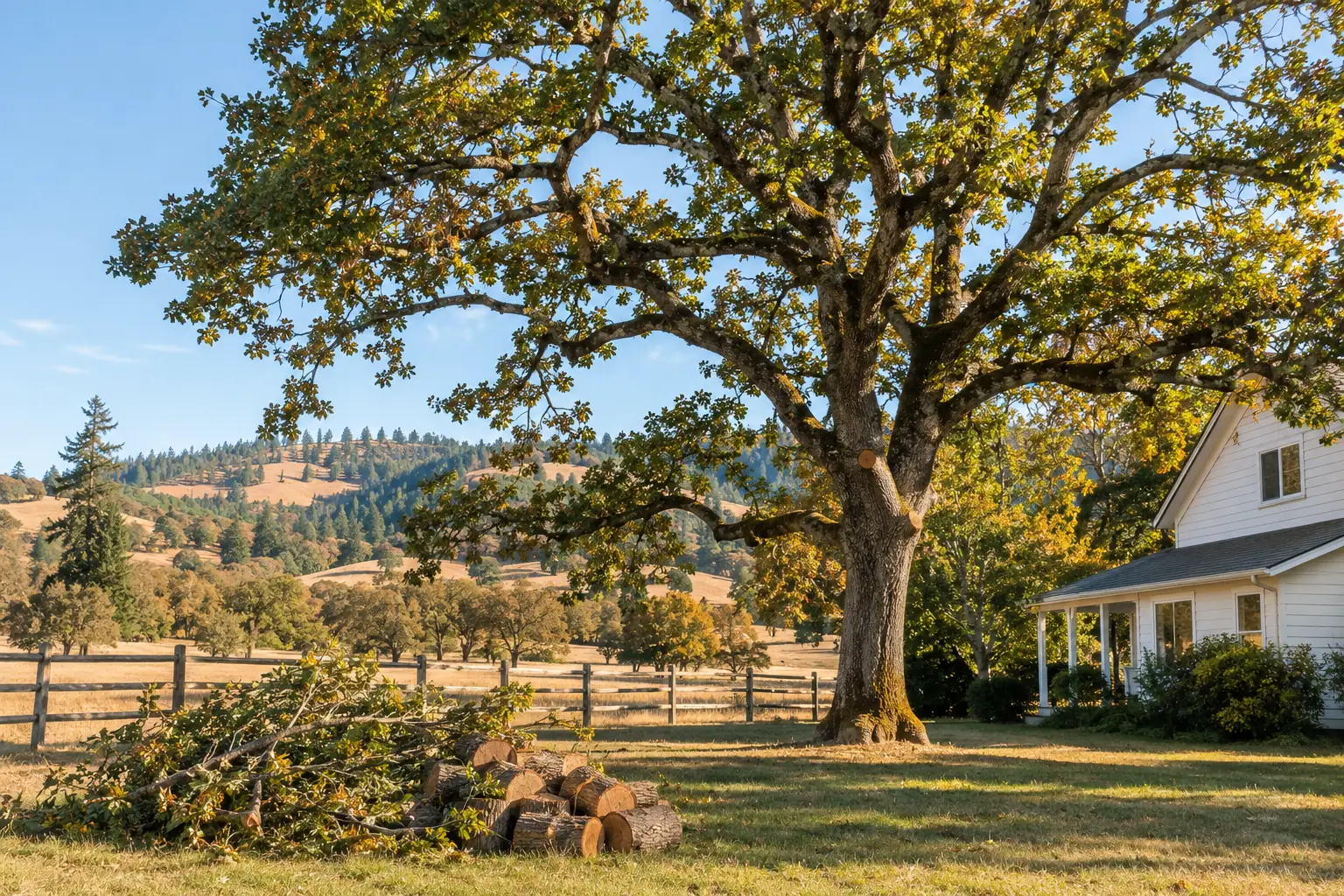
Tree trimming around Rogue River is the work of cutting chosen branches so a tree you keep stays sound, healthy and off the roof, the drive and the wires. Done well, it takes out dead wood and shortens limbs to live side branches. It never tops a tree. Dialing (541) 507-9640 costs nothing and reaches a single tree service holding an active Oregon CCB license. Get its price on paper before any cut.
This site handles only the introduction; the company does the pruning. Below is a short guide to tree care for trees worth keeping. The home page explains the referral.
Three words you will see on an estimate
Trimming and pruning mean the same thing in everyday talk: taking branches off on purpose. Crown reduction is a specific cut that makes a tree shorter or narrower. An estimate should say which kind of work you are paying for.
ISA, the International Society of Arboriculture, sorts mature tree work into a few named techniques in its brochure Pruning Mature Trees. Cleaning takes out dead, sick and poorly attached wood. Raising lifts the lowest limbs for clearance. Reduction cuts leaders and branch tips back to secondary branches. Density reduction removes some outer branches to let light or wind through.
The brochure says taking more than about a quarter of the crown at once is generally too much, less for mature trees, and that a reduction cut should end at a side branch at least a third as thick as the piece removed.
The case against topping
Topping chops big limbs back to stubs, or to twigs too small to become a new top. ISA's Why Topping Hurts Trees ranks it as perhaps the worst pruning practice there is and says it can leave a tree riskier than before.
The brochure explains why. Topping can strip half or more of the leaves that feed the tree. A thicket of shoots sprouts below each cut, anchored only in the outer wood, so wind and ice snap them, and in some species they grow up to 20 feet a year. Bared bark can sunburn, and stub wounds let decay in.
An October 2025 OSU Extension answer on topping tall oaks calls it very rarely appropriate and warns that it shortens the life of white oaks in particular.
Rogue River goes further for public trees. Its street tree code, section 12.20.130, forbids topping a street tree, park tree or any tree on public land as a normal practice, and treats cutting limbs to stubs over three inches thick, enough to wipe out the canopy, as topping. The committee can make an exception for storm-wrecked trees or trees under wires. A tree that has simply outgrown its spot is often better replaced; see large tree removal.
Seasons for local trees
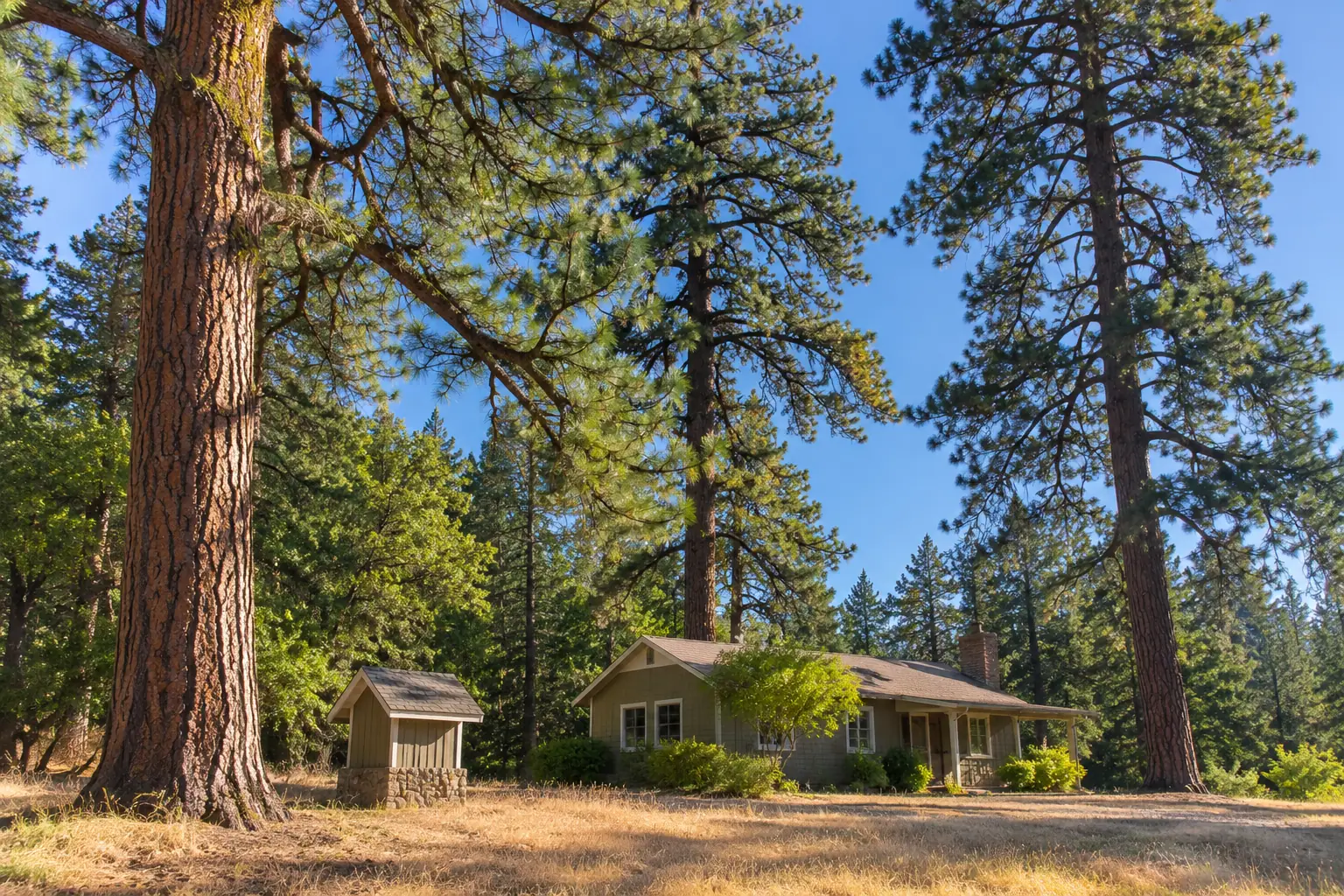
Timing depends on the species. ISA's mature tree brochure says small cuts to dead or weak wood can happen in any month, that trees close wounds best when pruned before spring growth starts, and that heavy cutting of live wood right after the spring flush is a bad idea.
| What grows on your lot | When to ask for pruning | Where the advice comes from |
|---|---|---|
| Oaks, madrone and other hardwoods | During dormancy | OSU Extension EC 1576 |
| Ponderosa pine, Douglas-fir and other conifers | October to February; skip spring and early summer | OSU Extension EC 1576 |
| Apples, pears and most home orchard trees | Once fall and early winter freeze danger is past, before buds break | OSU Extension PNW 400, revised February 2025 |
| Sweet cherry | August, when bacterial infection risk drops | OSU Extension PNW 400 |
EC 1576 explains the conifer window: sap runs in spring and early summer, which raises the odds of pitch moth attack, while pitch flow that draws harmful insects is lowest from October to February. It also says wound paint does no good and may seal decay in.
Pine debris has its own calendar. ODF's slash management fact sheet from April 2021 says Ips beetles breed in fresh pine limbs about 3 to 8 inches thick and can then attack living pines nearby. Limbs cut in October, November or December have time to dry before spring. Pine limbs cut between January and September should be burned, chipped or buried quickly. If your pines get pruned in summer, put same-day chipping or hauling on the estimate. The brush and debris removal page compares those choices.
Street trees inside city limits
For trees along a street in town, chapter 12.20 of the city code is the rulebook. The city's municipal code page links to the online text, which showed an August 27, 2026 date when this page was checked.
In plain terms, the chapter says:
- Keep the sidewalk and street clear. If your tree hangs over a street or right-of-way, you prune it. Leave eight feet open above the sidewalk, and keep limbs away from street lamps and out of drivers' sight lines at corners. Dead or dangerous trees and rotten limbs that threaten the public are yours to remove (section 12.20.140).
- The city can step in. It may order an owner to deal with a hazardous tree, and after 30 days without action, public works can do it and bill the cost as a lien on the lot (section 12.20.150).
- Tree businesses need a city license to prune, treat or remove street and park trees, backed by $2 million in liability coverage that protects the city (section 12.20.200).
- Fines reach up to $1,000 for breaking the chapter's rules (section 12.20.220).
For any tree near the curb, phone City Hall at (541) 582-4401, listed on the city's planning page, and ask the company if it carries the city license. The Rogue River tree rules guide covers the committee in more depth.
Trees beside Evans Creek and the Rogue
You can prune trees near water, but lightly. The city's riparian chapter, 17.135, protects a corridor reaching 75 feet back from the Rogue River's bank and 50 feet back from Evans Creek, Wards Creek and other fish-bearing streams.
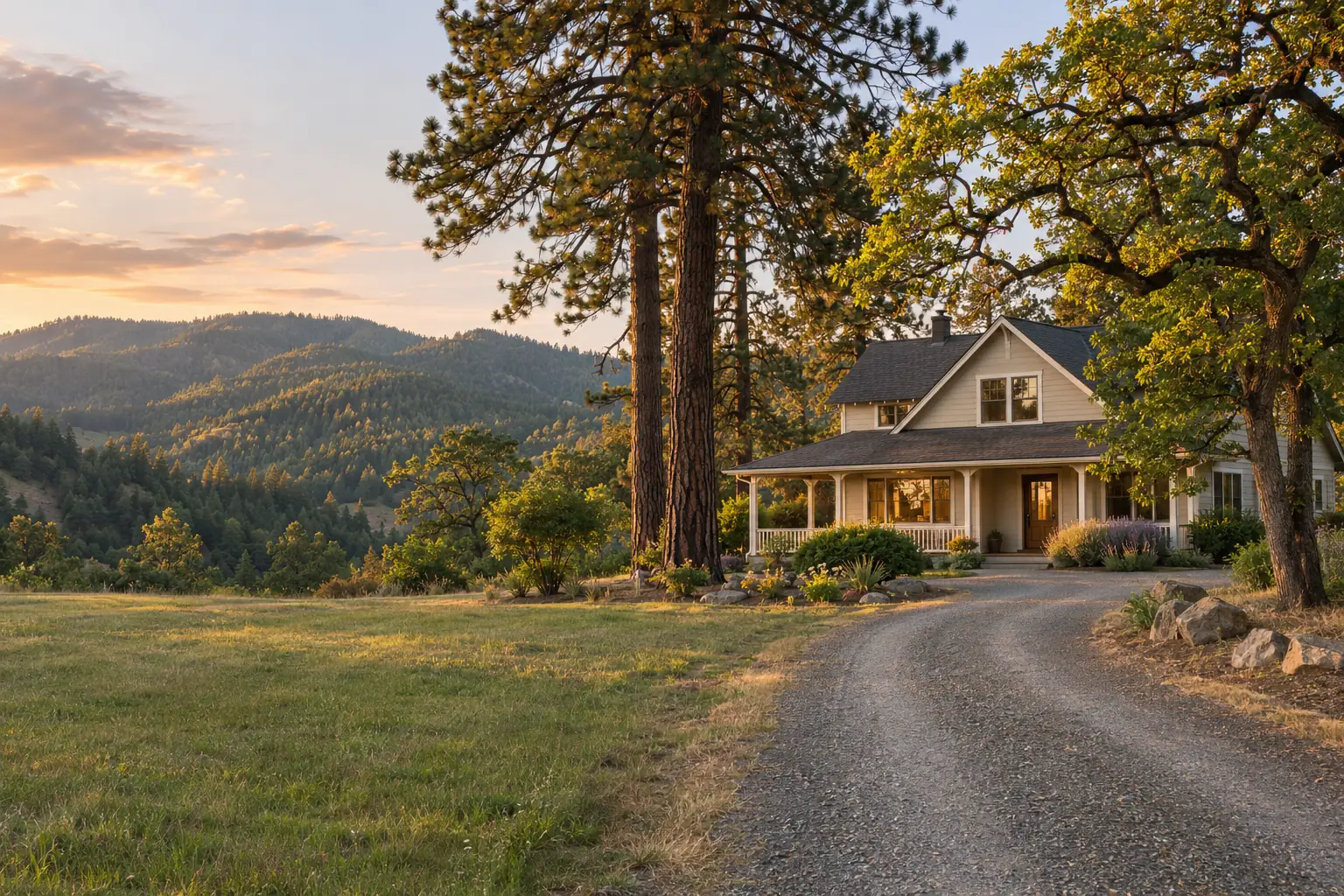
Inside that corridor the code permits upkeep trimming of existing trees, as long as it is never harsh enough to hurt the tree's health, lifespan or value to the stream. Upkeep pruning there should be minimal and follow ANSI A300, the national tree care standard. Yard waste cannot be left in the corridor, other than fallen trees, leaf litter from streamside plants and mulch for approved plantings, so plan for the trimmings to leave the bank.
Outside town, Jackson County's Land Development Ordinance, chapter 8, section 8.6.4, keeps vegetation and tree cover in place near the Rogue and fish-bearing streams and bars cutting understory or canopy there to satisfy fuelbreak rules. Talk to county planning before pruning near water on county land. The riverbank tree removal guide lists contacts.
Limbing up for fire on acreage
Lifting low branches breaks the ladder that carries a grass fire into the crowns, so it is the pruning job acreage owners ask for most. Official sources give targets:
- The Oregon State Fire Marshal's defensible space page suggests limbing trees to 6 feet and keeping crowns at least 10 feet apart.
- OSU's EC 1576, written for woodland fuels, goes higher, to 8 or 10 feet, while leaving at least a third of the tree's height in green crown and never removing more than half the live crown at once.
- Jackson County section 8.7.1 sets standards for new homes in mapped wildfire hazard areas: no dead branches and none lower than 10 feet, deciduous limbs at least 10 feet from the roof, evergreen limbs at least 25 feet away, and 10 feet clear of chimney outlets.
The county figures bind new construction only, but they make a good goal. Saws follow ODF's fire season hours, explained in the rural acreage guide. For thinning brush and small trees, see lot and land clearing.
Leave the wires to Pacific Power
Branches near overhead power lines are not a homeowner or general tree job. Pacific Power's tree page tells customers not to prune or remove trees near its lines and warns that accidental contact can kill. Its crews prune for clearance at no charge, and they inspect more often in places with higher wildfire risk. For work near the wire that feeds your house, the utility can arrange a free temporary disconnect. Its tree number is 1-888-221-7070.
What trimming costs
Tree height and how easily a crew can reach the tree drive most of the bill. LawnStarter's trimming cost guide, updated September 24, 2026, puts an average tree at $430 to $640 and the full spread at $78 to $1,835. In that guide, a short tree under 30 feet ran $85 to $415, a mid-height tree of 30 to 60 feet ran $215 to $790, and anything taller than 60 feet ran $475 to $1,835.
Those are national averages. Around Rogue River, expect these to push your number one way or the other:
- A bucket truck needs solid, open ground. Trees down a muddy pasture get climbed instead, which takes longer.
- Chipping on site, trucking brush to White City and leaving it piled are all priced differently.
- Several trees done on one visit usually cost less apiece.
- Short saw hours at moderate or high fire danger stretch the day.
Only the company's written estimate is a real price. If pruning will not solve the problem, the tree removal cost guide covers the next step.
Checklist for the estimate visit
These questions say a lot about how a company approaches tree care. Get the answers in writing.
- Which technique for each tree, and what share of the crown comes off?
- Will every shortened limb end at a live side branch, with no stubs?
- Does the work follow ANSI A300, and will an ISA Certified Arborist be on site? ISA's credential directory lets you look up a name.
- Is chipping or hauling the brush in the price?
- Which route will the truck take, and will it stay off the drainfield and the well line?
- For a tree by the street, does the company hold the city's tree license?
- What is the company's CCB number? Look it up on the Oregon CCB license search.
If the company finds rot or a crack that pruning cannot fix, read the hazard tree removal page.
Frequently asked questions
Is there a difference between trimming and pruning?
Not in daily speech; both mean removing branches on purpose. The estimate should name the actual technique, such as cleaning, raising or reduction, so you know what you are buying.
Can a tree be topped to make it shorter?
On public land in Rogue River, the street tree code bans topping as a normal practice. On private land it still backfires, since the regrowth is weak and soon taller. Ask for a reduction cut, or removal if the tree is too big for its spot.
What month is best for pruning oaks and pines?
OSU Extension says to prune hardwoods such as oaks while dormant and to avoid pruning conifers in spring and early summer. Fresh pine limbs cut between January and September should be chipped or hauled quickly so bark beetles cannot breed in them.
How much room do branches need above a Rogue River sidewalk?
Eight feet, under section 12.20.140 of the city code. Limbs also may not hide a street lamp or block the view at an intersection.